
Recombinant FGF2 146
Human Fibroblast Growth Factor 2 (FGF2, bFGF), is a heparin-binding cytokine that regulates proliferation, cell survival, migration, and differentiation. FGF2 signals by binding heparan sulfate proteoglycans on the cell surface to form a ternary complex with FGFR1-FGFR4, that drives receptor dimerization and phosphorylation, activating the MAPK/ERK, PI3K/AKT and PLCγ pathways.
Valor Scientific recombinant FGF2 146 corresponds to the full-length 146 amino acid (16.5kD) activated isoform responsible for extracellular FGFR binding and signaling. Valor FGF2 146 is produced in E. coli and is purified in our always-hydrated platform to retain native protein structure and bioactivity with >97% monomeric purity, for consistent lot-to-lot performance.
$252
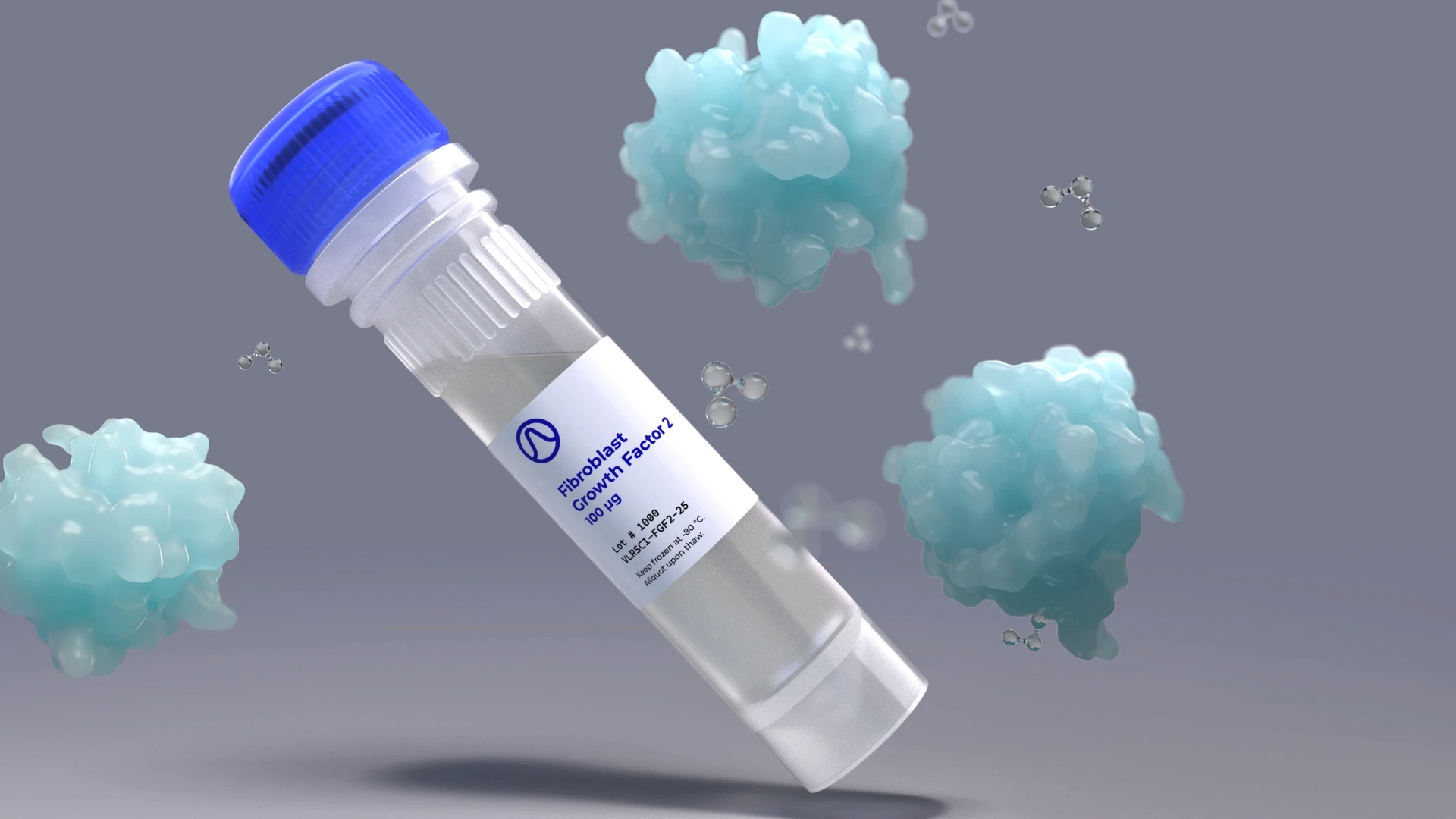
Product Specifications:
Property | Specification |
|---|---|
| Source | E. coli |
| Amino Acid Sequence | Human FGF2 (Pro143-Ser288), Accession P09038 |
| N-terminal Sequence | Gly-Pro143 |
| Predicted Molecular Mass | 16.5kD |
| Activity | Measured in ERK activity and proliferation assays in NIH-3T3 cells |
| Tag | Tag-free |
| Carrier | Carrier-free |
| Purity | >97% by stain-free SDS-PAGE |
| Endotoxin | <0.1.0 EU/ug |
| Formulation | 20 mM Tris-HCl, 150 mM NaCl, 10% trehalose pH 7.4 |
| Shipping | Dry ice |
| Storage | -80; avoid repeated freeze-thaws, aliquot after first thaw |
Biological Activity
Valor FGF2 146 is functionally validated using ERK phosphorylation and cell proliferation assays in NIH-3T3 cells, an FGF-responsive murine fibroblast line commonly used as the reference standard for FGF2 bioactivity testing. Biological activity is confirmed by dose-dependent induction of ERK1/2 phosphorylation and cell proliferation in a mitogenic-dependent manner.
Each lot is tested independently to ensure consistent bioactivity and lot-to-lot reproducibility.
FGF2 Stability Considerations in Cell Culture
Recombinant FGF2 has a half-life of approximately 10 hours at 37°C in cell culture media. To maintain sustained FGFR signaling during stem cell maintenance, supplemented cell culture media should be replaced every 24-48 hours.
To preserve Valor FGF2 146 bioactivity:
Avoid repeated freeze-thaw cycles by aliquoting into single-use volumes immediately after the first thaw to maintain bioactivity and protein integrity.
Store at -80°C; do not store at -20°C, to avoid temperature fluctuations that lead to protein degradation.
Avoid exposing reagent to room temperature exposure during reagent preparation.
Low-binding tubes and pipette tips should be used to avoid product loss.
Adding 0.1% bovine serum albumin (BSA) as a carrier protein prevents surface adsorption.
Do not vortex; gently flick or triturate with a pipette tip.
Recommended Working Concentrations
Working concentrations of FGF2 vary depending on cell type, culture conditions, and experimental objectives:
Applications | Concentration Range |
|---|---|
| Induced pluripotent stem cells (iPSC) | 10-100ng/ml |
| Neural progenitor/stem cell culture | 10-50ng/ml |
| Mesenchymal stem cell culture | 1-10ng/ml |
| Chondrocyte expansion | 1-10ng/ml |
| Endothelial cell proliferation | 1-10ng/ml |
| Fibroblast proliferation assays | 1-20ng/ml |
| Smooth muscle cell culture | 1-10ng/ml |
Optimal concentrations should be determined for each experimental condition based on cell line responsiveness, media formulation, and experimental duration.
Applications
Pluripotent stem cell (hPSC/iPSC) culture, maintenance, and expansion
Mesenchymal stem cell (MSC) proliferation and expansion
Neural progenitor and neural stem cell culture
Endothelial cell growth and angiogenesis studies
Chondrocyte expansion and cartilage tissue engineering
Organoid and 3D cell culture systems
Cell and gene therapy manufacturing
Induced pluripotent stem cell (iPSC) reprogramming
Receptor signaling and developmental biology research
Serum-free and defined media formulations
ELISA standard and immunoassay applications
Research Use
For Research Use Only (RUO). Not intended for diagnostic or therapeutic applications.
Frequently Asked Questions:
How is Valor FGF2-146 different from lyophilized FGF2?
How is biological activity validated?
What does >97% monomeric purity mean for my experiments?
Will I need to change my protocol to use Valor FGF2?
Can I replace my current supplier directly?
Does this reduce variability in my experiments?
How should I store and handle the product?
How does your shipping process differ from that of other suppliers?
How stable is FGF2 once added to media?
Can I refreeze the product after thawing?
What is the shelf life of the product?
Do you provide a Certificate of Analysis (COA)?
What is the intended use classification of this product?
Do you offer bulk or custom orders?
" height="39.80214192304729px" id="B9P9W9jFh" transform="translate(0 0.1)" width="213.9999991052989px"/></g></svg>)

FGF2